Preliminary Program
___________________________________________________________
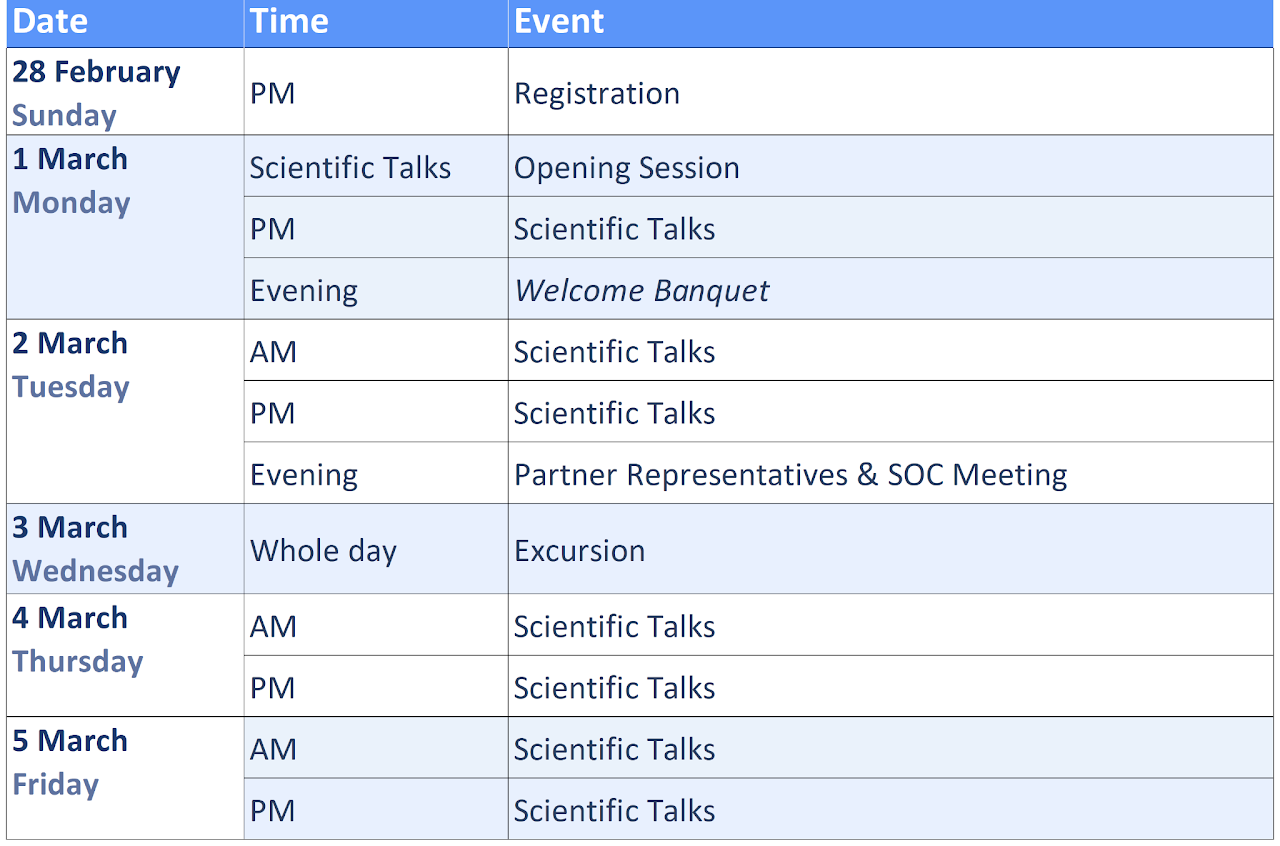
Date: 1–5 March, 2027
Venue: National Space Science Center, CAS (Huairou Campus), Beijing, China
Preliminary Program
___________________________________________________________
Date: 1–5 March, 2027
Venue: National Space Science Center, CAS (Huairou Campus), Beijing, China
Scientific Sessions
___________________________________________________________
Session 1: National and international contributions to the IMCP
Conveners: Qinghe Zhang, Michel Blanc
This session provides a comprehensive overview of the International Meridian Circle Program (IMCP), highlighting its recent progress and overall strategic vision. It brings together key domestic and international partner institutions to jointly review current collaborative achievements.
Session 2: New and outstanding science issues for IMCP
Conveners: Luca Spogli, Koki Chau, Michael Kosch
IMCP targets the geospace system by investigating both top-down energy inputs from solar drivers (solar radiation, solar wind, CMEs) and bottom-up influences from Earth's lower atmosphere and geological processes. We invite abstracts on critical open questions and emerging research directions in geospace science, including but not limited to:
Solar drivers of space weather: Mechanisms of energy release, transport, and impact on geospace environments;
Cross-layer energy coupling: Mass, momentum, and energy transport across the lithosphere, atmosphere, ionosphere, magnetosphere, and interplanetary space;
Global and regional geospace features: Multi-instrument monitoring of large-scale structures, local anomalies, and regional space weather responses;
Lithosphere-Atmosphere-Ionosphere Coupling: Observational and modeling insights into atmospheric dynamics, wave propagation, and electromagnetic responses triggered by lower-atmosphere and seismic/geological events.
Session 3: Instruments and networks for the IMCP
Conveners: Qinghe Zhang, Yao Chen, Koki Chau, Michael Kosch
Building upon existing monitoring facilities, the IMCP will integrate newly deployed instruments in key geospace regions to construct a globally distributed monitoring network for comprehensive, multi-scale diagnosis of the Sun-Earth system.This session highlights three core observational domains:
24/7 Solar Eruption Monitoring: Continuous tracking of solar radio bursts, flare microwave emissions, and solar magnetic fields;
Geospace and Atmosphere Coupling Monitoring: Combining global large-scale observations with targeted, fine-scale measurements in key regions (including the Subauroral Zone, South Atlantic Anomaly, Polar Regions, Southeast Asia, and Equatorial Africa);
Interdisciplinary Solid Earth Monitoring: Comprehensive diagnosis of geophysical fields from Earth's surface through the middle and lower atmosphere. We warmly invite abstracts on ground-based observation facilities and networks, novel instrumentation, innovative measurement techniques, and multi-instrument synergistic observation strategies.
Session 4: Modelling projects and tools, data systems and AI
Convener: Jiuhou Lei
This session highlights cutting-edge numerical models, innovative data systems, and AI applications in space weather research. Topics of interest include interplanetary solar eruption propagation, magnetosphere-ionosphere-thermosphere coupling, and AI-driven large-scale space weather forecasting designed to deliver high-precision digital intelligence for geospace weather. We invite contributions on space weather modeling, machine learning frameworks, data integration platforms, and interactive scientific software tools.
Session 5: New results from space observations, scientific synergies/coordinated observations between space platforms and ground-based assets
Conveners: Michel Blanc, Hui Tian
Space-based observation is the most essential means for global space weather monitoring. When combined with ground-based networks, it establishes a globally integrated monitoring system with complementary strengths. Currently, multiple key space environment missions are in operation worldwide, e.g. SDO, Solar Orbiter, Hinode, Aditya-L1, Fengyun-4, CHASE and ASO-S for solar activity; MMS, THEMIS, and SMILE for magnetospheric dynamics; as well as Swarm, GOLD, CSES, and COSMIC-2 for ionospheric monitoring—providing invaluable global observational data for solar-terrestrial research. Meanwhile, space environment monitoring is entering a new era of higher precision and comprehensive coverage, driven by next-generation heavy-duty space missions such as Vigil, GDC, Solar-C, LAVSO and SPO. This session focuses on these satellite missions and their synergistic strategies with IMCP, aiming to jointly build a seamlessly integrated space-ground observation network for the solar-terrestrial environment.
Session 6: Tools and programs for international cooperation within the IMCP and beyond
Conveners: Kazuo Shiokawa, Babatunde Rabiu
IMCP studies the space weather and associated system sciences through various instrumentations along approximately a meridian circle of 120°E/60°W passing through more than 10 countries and regions. This IMCP’s global measurements of geospace and the Earth’s atmosphere provide eminent opportunities for international cooperation of observation, data-handling, and modeling tools, as well as various domestic and international programs within and beyond the IMCP. This session invites papers dealing with all aspects of current and new tools and programs for the international cooperation of IMCP and beyond. Papers reporting the preparation for IMCP and completed IMCP activities such as workshops/schools are also welcome. The session also invites contributions capable of fostering international cooperation with IMCP.